
What Happens Inside a Concealed Cistern After You Press the Flush Button?
Every day, we press a flush button without giving it a second thought.
The water disappears, the toilet is cleaned, and within a few moments, everything is ready for the next use.
Simple, right?
Not quite.
Behind the wall, inside every concealed cistern, a carefully designed sequence of mechanical movements takes place in just a few seconds. These movements determine not only how well your toilet flushes, but also how much water is actually used, or wasted.
Surprisingly, not all concealed cisterns work the same way.
The First Second After You Flush
The moment you press the flush plate, the outlet valve opens.
Gravity takes over, allowing the stored water inside the cistern to rush into the toilet bowl with enough force to complete the flush.
At this point, every concealed cistern looks identical.
But this is exactly where the difference begins.
How a Conventional Concealed Cistern Works
In a conventional system, the inlet valve opens almost immediately after the flush starts.
While water is still leaving the cistern, fresh water has already started entering it.
From the outside, everything appears normal.
Inside the tank, however, two things are happening at the same time:
* Water is flowing out.
* Fresh water is flowing in.
This overlap might seem harmless, but it creates an inefficiency. Part of the incoming clean water contributes little to the flushing process because it enters before the cycle has finished.
It’s a small amount during each flush—but over weeks, months, and years, those small amounts accumulate.
Is There a Better Way?
Engineers asked a simple question:
Why refill the cistern before the flush has actually finished?
If the tank is still emptying, wouldn’t it make more sense to wait just a little longer before opening the inlet valve?
That simple idea led to a smarter flushing sequence.
A Smarter Sequence
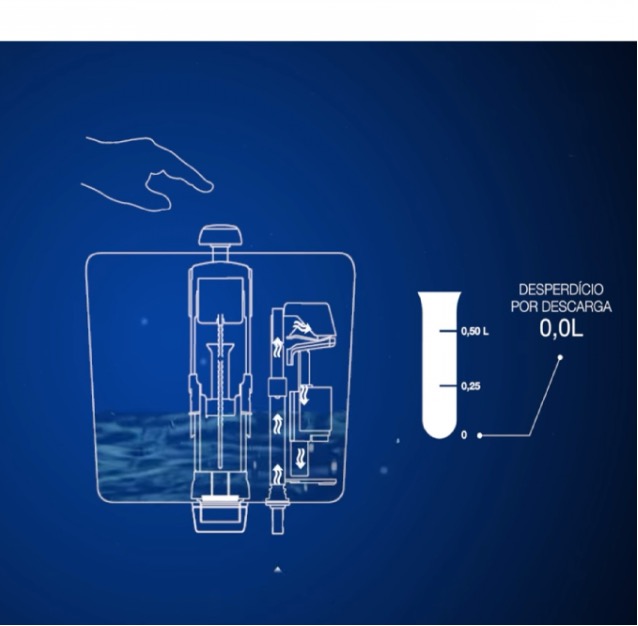
Instead of refilling immediately, the inlet valve remains closed throughout the flushing cycle.
The sequence becomes:
1. The flush button is pressed.
2. The outlet valve opens.
3. Water leaves the cistern.
4. The inlet valve stays closed.
5. The outlet valve closes.
6. Only then does the cistern begin to refill.
Nothing changes for the user.
The flush feels exactly the same.
But internally, the system works much more efficiently.
Why Timing Matters
The difference is only a few seconds.
Yet those few seconds prevent fresh water from entering while the flush is still in progress.
Instead of allowing clean water to mix with an active flush, the cistern completes one task before starting the next.
Think of it as waiting for one door to close before opening another.
It’s a small engineering improvement, but it makes the entire system more efficient.
How SANITERRA Smart Silent Technology Works
This is exactly the principle behind the SANITERRA Smart Silent Concealed Cistern.
Its delayed-refill technology keeps the inlet valve closed while the outlet valve is open.
Only after the flushing cycle has completely finished does the inlet valve open and quietly refill the cistern.
This intelligent sequence offers several advantages:
* No unnecessary water enters during flushing.
* Approximately 0.5 litres of water can be saved with every flush.
* A typical family can save up to 9 litres of water per day.
* Overall water consumption can be reduced by up to 12%.
* The refill process is smoother and quieter.
The best part?
The user doesn’t have to do anything differently.
The system works automatically, every single time.
Smart Engineering Isn’t Always Visible
When choosing a concealed cistern, most people compare flush plates, frame strength, installation depth, or dual-flush volumes. BUT …
Very few ask an equally important question too:
What happens inside the tank after I press the flush button?
The answer reveals a difference you can’t see, but one you’ll benefit from every day.
Sometimes, innovation isn’t about adding more features.
Sometimes, it’s simply about making the sequence smarter.
And in the case of a concealed cistern, a smarter sequence means quieter operation, less wasted water, and better performance with every flush.
