Tag: wall hung toilet

Why Does My Toilet Keep Running? Causes, Easy Fixes & When to Replace It?

If your toilet keeps running after flushing, the problem is usually caused by a worn flush valve, a faulty fill valve, an incorrectly adjusted float, or a leak inside the concealed cistern. Many of these issues are inexpensive to repair, but older toilets or outdated flushing systems may be worth replacing for better water efficiency.

You Flush… But the Water Never Seems to Stop

You flush the toilet, walk away, and a few minutes later you still hear water running.

It may seem like a small annoyance, but a continuously running toilet can waste a surprising amount of water over time and increase your utility bill.

The good news? Most running toilets have a simple cause, and many problems can be fixed without replacing the entire toilet.

Why Does a Toilet Keep Running?

Here are the most common reasons.

1. A Worn Flush Valve Seal

The flush valve seal (sometimes called the flapper seal) prevents water from escaping the cistern after flushing.

Over time, rubber seals can become worn, stiff or damaged. Even a small gap allows water to leak continuously into the toilet bowl, forcing the cistern to refill again and again.

What you can do

* Remove the flush plate or cistern lid (depending on your installation).
* Check whether the seal looks damaged or covered in limescale.
* Replace it if necessary.

2. The Fill Valve Isn’t Closing Properly

The fill valve controls how the cistern refills after every flush.
If it sticks or becomes worn, water may continue entering the cistern even after it is full.
This is one of the most common causes of a constantly running toilet.

Signs

* A hissing sound after flushing.
* Water trickling into the bowl.
* The cistern never seems completely quiet.

3. The Float Is Set Too High

Inside every cistern is a float that tells the fill valve when to stop.
If the float sits too high, water rises above the overflow level and flows continuously into the toilet.
Fortunately, this is often a simple adjustment.

4. Limescale Build-Up

If you live in a hard water area, mineral deposits can affect moving parts inside the cistern.
Limescale may prevent valves from sealing properly, leading to continuous water flow.
Regular maintenance helps reduce this problem.

Is a Running Toilet Serious?

Usually, no.
However, ignoring the problem can:

* Waste hundreds of litres of water over time.
* Increase water bills.
* Wear out internal components faster.
* Lead to more expensive repairs later.

Fixing the issue early is almost always the better option.

When Should You Call a Plumber?

Consider professional help if:

* You’ve replaced the seal but the problem continues.
* Water leaks outside the toilet.
* The concealed cistern cannot be accessed easily.
* The toilet is more than 15 years old and several parts are failing.

Could a Modern Toilet Help?

If your toilet is older, replacing individual parts may not always be the most cost-effective long-term solution.
Modern rimless toilets are generally easier to clean because there is no hidden rim where dirt and bacteria can accumulate.

Some newer flushing systems also improve bowl cleaning while reducing water consumption and operating noise.

For example, Saniterra’s Vortex flushing technology creates a controlled circular flow of water that helps clean the bowl more evenly than many conventional flushing systems.

Saniterra Vortex System

Some concealed cisterns, including Saniterra’s Smart Silent Concealed Cistern, are also designed to delay refilling until the flush cycle has finished. This reduces unnecessary water movement inside the tank, lowers operating noise and can help save up to 9 litres of water per day for a typical family of four under normal household use.

These technologies won’t solve a damaged valve in an existing toilet, but they are worth considering if you’re planning a bathroom renovation or replacing an ageing toilet.

FAQ

Why does my toilet keep running even after replacing the flapper?

The problem may be caused by the fill valve, float adjustment or mineral deposits inside the cistern rather than the flush valve seal.

Can a running toilet increase my water bill?

Yes. Even a slow leak can waste a significant amount of water if left untreated.

Is it safe to keep using a running toilet?

Usually yes, but it should be repaired as soon as possible to prevent unnecessary water waste.

How long should a toilet flushing mechanism last?

Most quality flushing components last between 8 and 15 years, depending on water quality, usage and maintenance.

Final Thoughts

A toilet that keeps running is one of the most common plumbing problems, but it’s also one of the easiest to diagnose.

In many cases, replacing a worn seal, adjusting the float or servicing the fill valve is enough to restore normal operation. If your toilet is older or you’re renovating your bathroom, upgrading to a modern rimless toilet with an efficient concealed cistern can improve hygiene, reduce water consumption and provide quieter day-to-day performance.

What Happens Inside a Concealed Cistern After You Press the Flush Button?

Every day, we press a flush button without giving it a second thought.

The water disappears, the toilet is cleaned, and within a few moments, everything is ready for the next use.

Simple, right?

Not quite.

Behind the wall, inside every concealed cistern, a carefully designed sequence of mechanical movements takes place in just a few seconds. These movements determine not only how well your toilet flushes, but also how much water is actually used, or wasted.

Surprisingly, not all concealed cisterns work the same way.

The First Second After You Flush

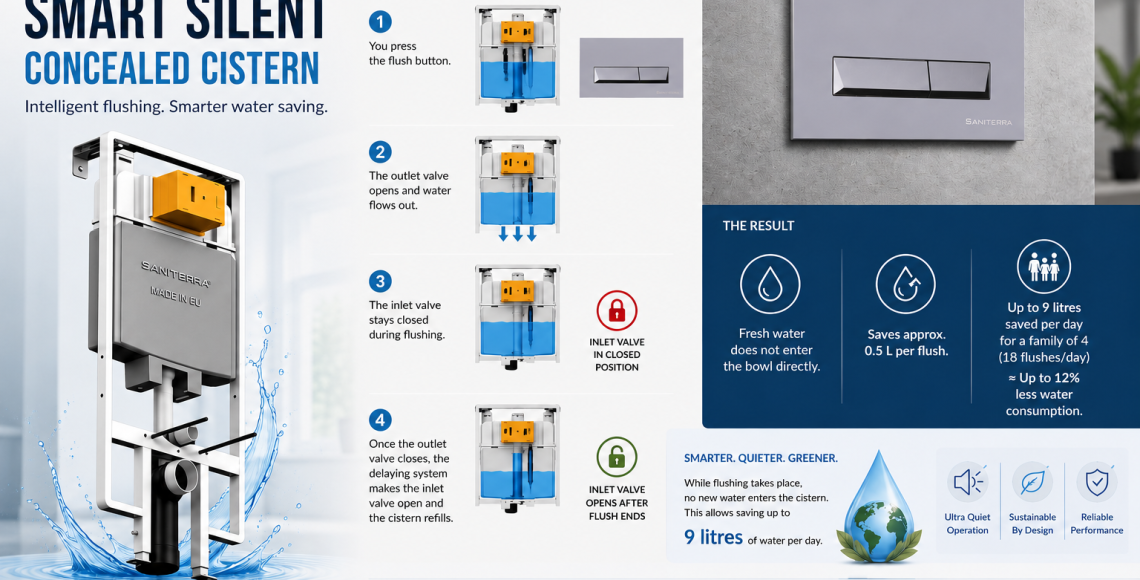
The moment you press the flush plate, the outlet valve opens.

Gravity takes over, allowing the stored water inside the cistern to rush into the toilet bowl with enough force to complete the flush.

At this point, every concealed cistern looks identical.

But this is exactly where the difference begins.

How a Conventional Concealed Cistern Works

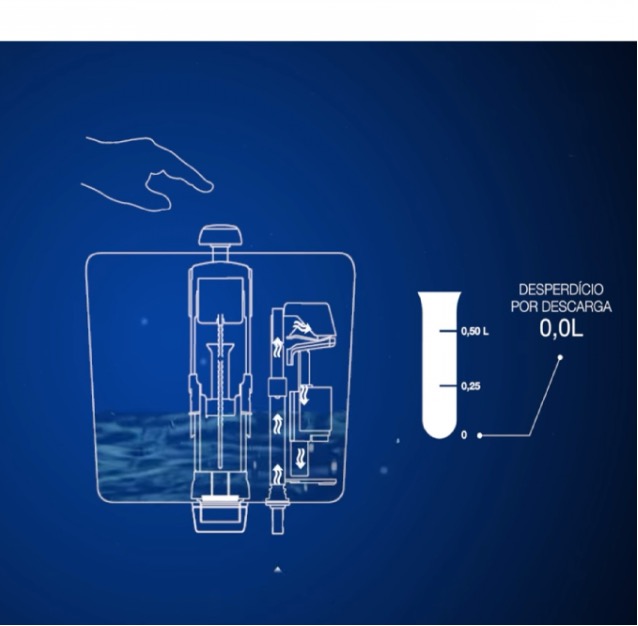
In a conventional system, the inlet valve opens almost immediately after the flush starts.

While water is still leaving the cistern, fresh water has already started entering it.

From the outside, everything appears normal.

Inside the tank, however, two things are happening at the same time:

* Water is flowing out.
* Fresh water is flowing in.

This overlap might seem harmless, but it creates an inefficiency. Part of the incoming clean water contributes little to the flushing process because it enters before the cycle has finished.

It’s a small amount during each flush—but over weeks, months, and years, those small amounts accumulate.

Is There a Better Way?

Engineers asked a simple question:

Why refill the cistern before the flush has actually finished?

If the tank is still emptying, wouldn’t it make more sense to wait just a little longer before opening the inlet valve?

That simple idea led to a smarter flushing sequence.

A Smarter Sequence

Instead of refilling immediately, the inlet valve remains closed throughout the flushing cycle.

The sequence becomes:

1. The flush button is pressed.
2. The outlet valve opens.
3. Water leaves the cistern.
4. The inlet valve stays closed.
5. The outlet valve closes.
6. Only then does the cistern begin to refill.

Nothing changes for the user.

The flush feels exactly the same.

But internally, the system works much more efficiently.

Why Timing Matters

The difference is only a few seconds.

Yet those few seconds prevent fresh water from entering while the flush is still in progress.

Instead of allowing clean water to mix with an active flush, the cistern completes one task before starting the next.

Think of it as waiting for one door to close before opening another.

It’s a small engineering improvement, but it makes the entire system more efficient.

How SANITERRA Smart Silent Technology Works

This is exactly the principle behind the SANITERRA Smart Silent Concealed Cistern.

Its delayed-refill technology keeps the inlet valve closed while the outlet valve is open.

Only after the flushing cycle has completely finished does the inlet valve open and quietly refill the cistern.

This intelligent sequence offers several advantages:

* No unnecessary water enters during flushing.
* Approximately 0.5 litres of water can be saved with every flush.
* A typical family can save up to 9 litres of water per day.
* Overall water consumption can be reduced by up to 12%.
* The refill process is smoother and quieter.

The best part?

The user doesn’t have to do anything differently.

The system works automatically, every single time.

Smart Engineering Isn’t Always Visible

When choosing a concealed cistern, most people compare flush plates, frame strength, installation depth, or dual-flush volumes. BUT …

Very few ask an equally important question too:

What happens inside the tank after I press the flush button?

The answer reveals a difference you can’t see, but one you’ll benefit from every day.

Sometimes, innovation isn’t about adding more features.

Sometimes, it’s simply about making the sequence smarter.

And in the case of a concealed cistern, a smarter sequence means quieter operation, less wasted water, and better performance with every flush.

Wall-Mounted vs Floor Standing Toilets

In modern bathroom architecture and design, the choice of toilet type affects not only comfort and hygiene but also the overall aesthetics, sense of cleanliness, and luxury of the space. The two most popular options are wall-mounted toilets and back-to-wall floor-standing toilets.
In this article, we will compare these two types and focus on the Saniterra Vortex system, exploring how it improves flushing performance compared to conventional systems while also enhancing hygiene, design freedom, and sustainability.

The Flushing System: Why It Matters

The flushing system is one of the most critical components of any toilet, directly affecting hygiene, water efficiency, noise level, and ease of maintenance.

Rimless Technology

In rimless toilets, the traditional rim around the bowl is completely removed. Instead, water is directed evenly around the entire inner surface during each flush. This design eliminates hidden areas where dirt, limescale, or bacteria could accumulate—resulting in easier cleaning, enhanced hygiene, and a more efficient flush.

The Vortex System

The Saniterra Vortex system is engineered to guide the water in a dynamic, swirling motion – creating a vortex that ensures every part of the bowl is cleaned effectively.
Key advantages of the Vortex flush include:
  • Full surface coverage for a spotless finish
  • Reduced residue and staining inside the bowl
  • Less frequent cleaning required
  • Lower flushing noise, thanks to smooth water flow
  • Water efficiency, achieved by maximizing cleaning power with less water
In short, a good flushing system—especially when designed like Saniterra’s Vortex – balances pressure, coverage, and eco-friendly water use to deliver optimal performance.

Wall-Mounted vs Floor-Standing (Back-to-Wall) Toilets:

When designing modern bathrooms and washrooms, the choice of toilet plays a crucial role—not only in comfort and hygiene but also in shaping the overall aesthetic and feeling of space. Two of the most popular choices today are wall-mounted and floor-standing back-to-wall toilets.
Below, we’ll compare these two styles and explore the advantages of Saniterra’s innovative Vortex system, which redefines flushing efficiency, hygiene, and design flexibility.

Design and Aesthetics

The wall-mounted toilet stands out for its minimalist look.
The bowl is suspended above the floor, creating a sense of openness and lightness.
With clean lines and the cistern concealed inside the wall, the result is a sleek, elegant, and luxury appearance that fits perfectly in modern interiors.

In contrast, the back-to-wall (floor-standing) toilet has a more classic silhouette.
Its bowl rests directly on the floor, which can occupy more visible space, it often conveys a traditional atmosphere.

Space Requirements

Because a wall-hung toilet does not touch the floor, the visible area beneath it remains free, making cleaning effortless and the space appear larger.
This makes it ideal for compact bathrooms, where designers aim to maintain open lines and visual continuity.

The floor-standing (back-to-wall) toilet, on the other hand, has a full pedestal in contact with the floor. While still elegant, cleaning around the base can be slightly more demanding.

Installation and Stability

Installing a wall-mounted toilet requires a strong in-wall frame capable of supporting the weight of the toilet and the user. It’s a more technical installation process, but once complete, the result is extremely stable and visually seamless.

A floor-standing (back-to-wall) toilet is easier to install, especially in renovation projects. Existing floor outlets can often be reused, which makes it a cost-effective and practical choice for replacing older toilets without major wall modifications.

Hygiene and Cleaning

Both types of toilets offer improved hygiene compared to older rimmed systems. Thanks to the Rimless technology, there are no hidden edges inside the bowl where dirt or bacteria can accumulate.

This ensures a more efficient flush and easier cleaning.

In back-to-wall models, the only area that may collect dust or residue is the joint between the bowl and the floor — yet with proper installation and Saniterra’s smooth ceramic coating, this is minimal.

Noise Levels

In both, the concealed cistern inside the wall significantly reduces the sound of flushing and refilling.
If paired with Saniterra’s Smart Silent Concealed flush systems, the operation becomes almost silent — a major advantage in luxury hotels, apartments, and multi-unit buildings.

Color Variety and Design Flexibility

Saniterra offers a wide palette of 12 colors across its entire collection — toilets, basins, bathtubs, shower trays, and faucets — allowing designers to create perfect harmony or striking contrasts within any bathroom interior.
This color flexibility enables personalized, coordinated designs where every element complements the others – from tiles and walls to lighting and décor.

Nouvo Tuscano toilet

The Role of Color in Luxury and Commercial Spaces

The ability to choose colors and finishes – in both wall-hung and floor-standing models – gives architects and designers complete creative freedom:
•Toilet colors can be perfectly matched with tiles, vanities, mirrors, bathtubs, faucets, and accessories.
Saniterra’s range includes White, Cream, Coffee, Magnesium, Sand, Green, Pink, Sky Blue, Graphite, Ice, Beige, and Grey, enabling truly customized combinations.
•In luxury hotels and restaurants, colored ceramics with glossy or matte finishes combined with lighting can create a unique, signature atmosphere.
•Light tones help make small spaces feel larger, while dark or graphite hues convey sophistication and modern elegance.

Saniterra Vortex: The Next Generation of Flushing

Saniterra’s exclusive Vortex System represents a major step forward in toilet flushing technology.
Whether installed in wall-hung or floor-standing models, it offers a range of unmatched benefits:
  • Dynamic Vortex Flow: The flush directs water in a smooth, circular vortex that completely covers the inner bowl — ensuring powerful, uniform cleaning with no blind spots.
  • Superior Hygiene (Rimless Design): The rimless bowl eliminates hidden edges, preventing limescale and bacterial buildup.
  • Noise Reduction: Precision design and optimized water flow ensure an almost silent flush — ideal for luxury environments.
  • Water Efficiency: The intelligent vortex system achieves full cleaning with less water, significantly reducing overall consumption.
  • Color Customization: Saniterra allows full aesthetic freedom with an extensive range of colors, letting designers combine toilets, basins, shower trays, tiles, furniture, and lighting for cohesive luxury interiors.

Choosing the Right Model

1.Assess the wall structure and space.
Wall-mounted models require solid walls and compatible in-wall frames.
Saniterra’s concealed systems are compatible with all dual-flush tanks on the market.
2.Prioritize advanced flushing systems.
Choose systems like Vortex and Rimless for maximum hygiene and water efficiency.
3.Consider maintenance accessibility.
Saniterra’s in-wall flush plates provide easy access for maintenance — though with their high reliability, you’ll rarely need it.
4.Coordinate colors and finishes.
Treat the toilet as part of the overall design palette: light tones for openness, bold colors for emphasis.
5.Think long-term.
Installation cost, maintenance, water consumption, and cleaning convenience all impact long-term value.
Saniterra concealed cistern can save up to 9 liters of water per person per day while remaining nearly silent.
If you seek:
•Modern, minimalist design,
•Quiet performance,
•Superior hygiene, and
•Color options 
then a wall-mounted Saniterra toilet with the Vortex system is your ideal choice for luxury homes, hotels, and restaurants.
For projects with existing plumbing or limited wall modification options, the floor-standing (back-to-wall) version offers an equally elegant and practical solution.
With its Vortex technology, silent operation, and bespoke color possibilities, Saniterra empowers designers, architects, and homeowners to achieve the perfect balance between performance, hygiene, and timeless beauty.